
Ephraim and Manasseh
Technical Appendix and Exhibit Packet
Technical Appendix and Exhibits
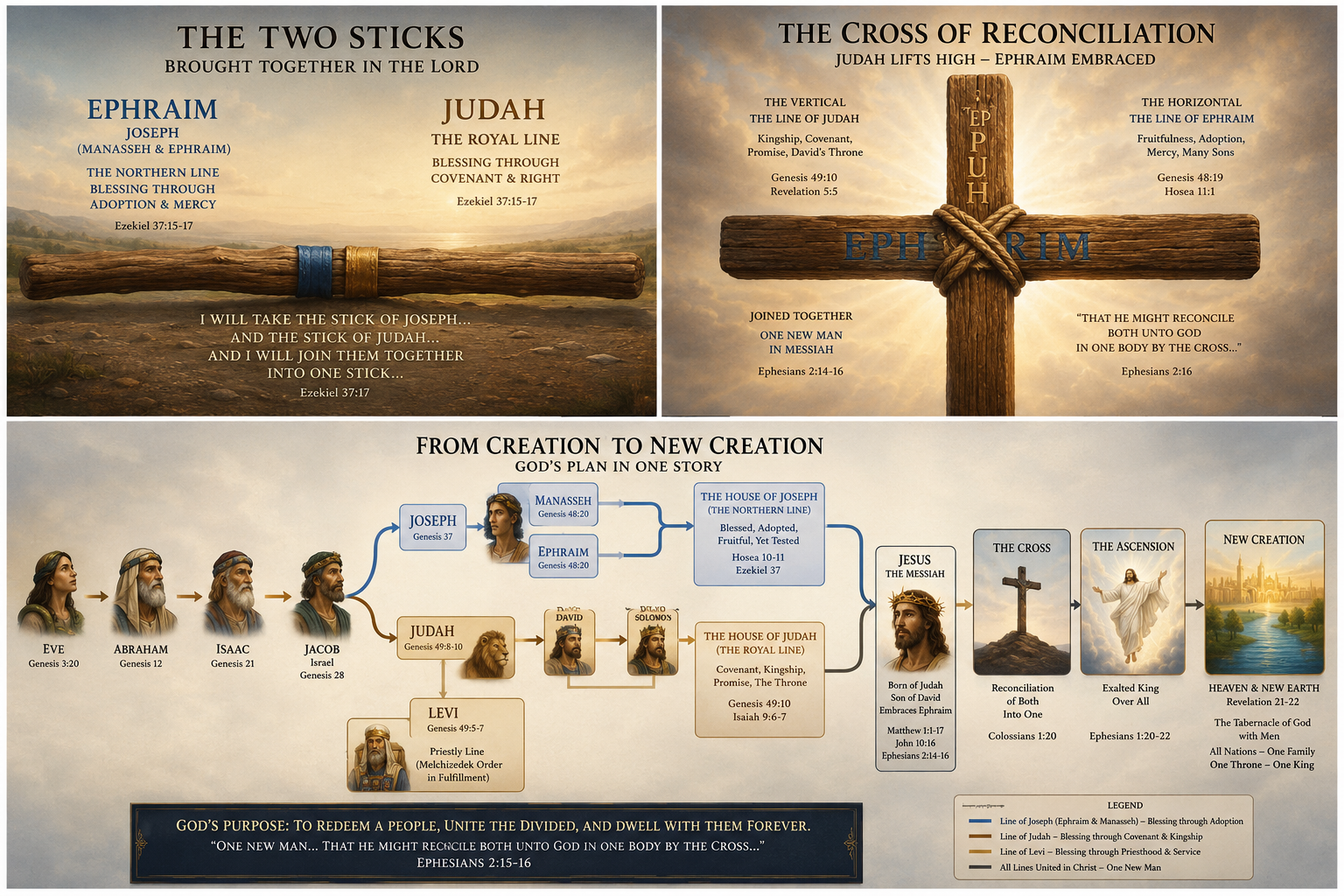
Opening Orientation for Packet 10#
Packets 1-9 carried the main argument in sequence: promise, Joseph in Egypt, Genesis 48, Reuben's forfeiture, Manasseh's preserved inheritance, Hosea's diagnosis and hope, Joshua's refuge pattern, Psalm 78 and Ezekiel 37, and Christ's fulfillment as Priest-King. Packet 10 now gathers the supporting material into one technical appendix.
This packet is not meant to replace the main study. It is meant to preserve the material that would otherwise make the main packets too heavy: root notes, city-name sequences, speculative but useful narrative strings, pictographic observations, and cross-reference banks. The central burden remains Scripture. The supporting material is preserved because the study is a discovery study, and the details matter.
The aim is to protect both sides: the main flow remains readable, and the technical trails are not lost. Some material is direct and strong. Some material is supportive. Some material remains speculative and must be labeled as such. That distinction does not make the supporting observations worthless; it keeps the burden of proof honest.
How to Use the Exhibit Packet#
The exhibit packet should be read alongside the main packets, not before them. The main packets give the legal and covenantal argument. The exhibits provide deeper support for review, refinement, and future expansion.
1. Read the main packet first so the argument has a scriptural spine.
2. Use the exhibit when a city name, root note, or typological connection needs more detail.
3. Keep direct Scripture above all supporting methods.
4. Preserve speculative observations, but mark them as observations or working hypotheses.
5. Return to the verses repeatedly. The goal is not novelty; the goal is to see the wisdom of God already present in the text.
Exhibit A. Method Hierarchy and Guardrails#
This study uses multiple types of evidence. They are not all equal in authority. The hierarchy below should govern how the material is written, taught, revised, and defended.
Level | Evidence Type | Function in the Study | Guardrail |
|---|---|---|---|
Level 1 | Direct Scripture | Narrative, covenant promise, legal command, prophecy, apostolic interpretation, and explicit fulfillment language. | This governs the argument and carries the burden of proof. |
Level 2 | Legal / Covenantal Structure | Adoption, birthright, firstborn forfeiture, inheritance law, cities of refuge, high-priest death, tribal allocation, joined-stick prophecy. | This organizes Scripture's mechanics and prevents sentimental flattening. |
Level 3 | Lexical / Name / Geography Support | Hebrew roots, name meanings, city names, tribal territories, burial locations, repeated motifs. | This supports and sharpens the pattern; it should not overthrow direct context. |
Level 4 | Typological and Canonical Inference | Joshua as shadow-type, Joseph patterns, Galilee resurrection commission, refuge pattern in Hebrews. | Label as typology or inference unless the New Testament explicitly states fulfillment. |
Level 5 | Pictographic / Visual Echo | Letter-symbol meditation, hand/nail/door/open-hand echoes, visual reinforcement. | Do not use as independent proof. Use as supplemental reinforcement after Scripture has carried the structure. |
Exhibit B. Asenath, Potiphera, On, and Egypt's Sacred Counterfeit#
Genesis 41:45
And Pharaoh called Joseph's name Zaphnath-paaneah; and he gave him to wife Asenath the daughter of Potipherah priest of On. And Joseph went out over all the land of Egypt.
Genesis 41:50-52
And unto Joseph were born two sons before the years of famine came, which Asenath the daughter of Potipherah priest of On bare unto him. And Joseph called the name of the firstborn Manasseh... And the name of the second called he Ephraim...
The detail must be stated carefully. Asenath is not said to be Pharaoh's own daughter. Scripture identifies her as the daughter of Potiphera, priest of On. Pharaoh gives her to Joseph as wife. Therefore the marriage is authorized by Egypt's throne and tied to Egypt's priestly world, but the text does not make her Pharaoh's biological daughter.
This correction does not weaken the symbolic layer. It strengthens it. Joseph's double portion inside Israel comes through sons born in Egypt from Joseph and an Egyptian woman of priestly-house background. When Jacob adopts Ephraim and Manasseh into Israel, the covenant name of Abraham, Isaac, and Jacob is placed on sons who are Israelite through Joseph and Egyptian through Asenath.
Element | Textual Detail | Study Significance |
|---|---|---|
Joseph | Son of Jacob/Israel; rejected by brothers; exalted in Egypt. | Promise-line suffering and exaltation; provision for Israel and Egypt. |
Pharaoh | Gives Asenath to Joseph and elevates Joseph over Egypt. | World-throne authorization; Joseph rules in a Gentile/nation context. |
Asenath | Daughter of Potiphera, priest of On. | Egyptian woman, priestly-house association, foreign-woman incorporation into Joseph's fruitfulness. |
Manasseh | Born in Egypt; name tied to God causing Joseph to forget toil. | Preserved inheritance, grief answered, endangered house not erased. |
Ephraim | Born in Egypt; name tied to God making Joseph fruitful in affliction. | Double fruitfulness, nations-multitude, later corrupted in Hosea and redeemed in Christ. |
Exhibit C. Birthright, Ruler, Double Portion, and Tribal Function#
1 Chronicles 5:1-2
Now the sons of Reuben the firstborn of Israel... forasmuch as he defiled his father's bed, his birthright was given unto the sons of Joseph the son of Israel... For Judah prevailed above his brethren, and of him came the chief ruler; but the birthright was Joseph's.
This passage is the legal hinge of the whole study. It prevents two errors. First, it prevents the erasure of Joseph/Ephraim, because Scripture says the birthright was Joseph's. Second, it prevents Joseph/Ephraim from replacing Judah, because Scripture says Judah prevailed and from Judah came the chief ruler.
Line / Function | Bearer | Core Texts | Study Use |
|---|---|---|---|
Forfeited firstborn | Reuben | Genesis 35:22; Genesis 49:3-4; 1 Chronicles 5:1 | The firstborn place is wounded by sin and cannot simply continue unchanged. |
Birthright / double portion | Joseph's sons | Genesis 48; 1 Chronicles 5:1-2 | Joseph receives the double portion through Ephraim and Manasseh. |
Ruler / scepter | Judah | Genesis 49:8-12; 1 Chronicles 5:2; Psalm 78:67-72 | The King line remains Judah; Joseph does not replace Judah. |
Preserved inheritance | Manasseh | Genesis 48:19; Numbers 27; Numbers 36; Joshua 17 | Manasseh testifies that God preserves endangered inheritance. |
Multiplied fruitfulness | Ephraim | Genesis 48:19; Hosea 10-11; Ezekiel 37 | Ephraim's fruitfulness must be brought under Judah's King. |
Exhibit D. Genesis 48 Blessing Language#
Genesis 48 should be preserved as the center of the study because it contains adoption, name-transfer, crossed hands, the God-Shepherd-Angel-Redeemer formula, nation/nations language, Ephraim's elevation, and the Shechem/portion bridge.
Genesis 48 Element | Phrase / Detail | Study Significance |
|---|---|---|
Adoption | Ephraim and Manasseh... are mine; as Reuben and Simeon, they shall be mine. | The Egyptian-born sons are legally brought into Israel's house and tribal inheritance. |
God of the fathers | The God before whom my fathers Abraham and Isaac did walk. | The blessing is anchored in the Abraham/Isaac/Jacob promise line. |
Shepherd | The God which fed/shepherded me all my life long unto this day. | Jacob identifies God's lifelong shepherding care. |
Angel-Redeemer | The Angel which redeemed me from all evil, bless the lads. | Jacob invokes the Redeemer-Angel in the blessing, supporting the Eternal Son / Shepherd / Redeemer thread. |
Name-transfer | Let my name be named on them, and the name of my fathers Abraham and Isaac. | Covenant identity is placed on Joseph's sons. |
Multiplication | Let them grow into a multitude in the midst of the earth. | The multiplication language bears a fish-like abundance echo, supporting the later Galilee/fish/nations meditation. |
Crossed hands | Israel stretched out his right hand, and laid it upon Ephraim's head. | Jacob sees beyond natural birth order and intentionally elevates Ephraim. |
Ephraim's destiny | His seed shall become a multitude/fullness of nations. | Ephraim carries the nations-fruitfulness thread, not the ruler line. |
Shechem / portion | I have given to thee one portion above thy brethren. | Joseph's inheritance points forward to Shechem, Joseph's bones, Ephraim territory, and refuge. |
Exhibit E. Name and Root Notes: Joseph, Manasseh, Ephraim, Judah#
The following table preserves name-level observations used in the study. The lexical meanings are supporting witnesses. Pictographic notes should be treated as echo material and are collected more fully in Exhibit K.
Name | Core Meaning / Association | Textual Anchor | Study Function |
|---|---|---|---|
Joseph | Adding, increase, may He add. | Genesis 30:24; Genesis 41; Genesis 48 | Joseph is rejected, exalted, and becomes the father through whom the double portion is formed. |
Manasseh | Causing to forget. | Genesis 41:51 | God answers toil, grief, and affliction; Manasseh preserves the endangered inheritance. |
Ephraim | Fruitfulness / double fruitfulness. | Genesis 41:52; Genesis 48:19 | God makes Joseph fruitful in affliction; Ephraim carries nations-multitude language. |
Judah | Praise; associated with hand/open-hand roots in supporting notes. | Genesis 29:35; Genesis 49:8-12 | Judah carries scepter, ruler, David, Zion, and Messiah line. |
Israel | Jacob's covenant name after wrestling / prevailing. | Genesis 32:28; Genesis 35:10 | The name placed on Ephraim and Manasseh is covenant identity, not mere family label. |
Exhibit F. Manasseh and Zelophehad's Daughters#
Numbers 27:4
Why should the name of our father be done away from among his family, because he hath no son? Give unto us therefore a possession among the brethren of our father.
Numbers 27:7
The daughters of Zelophehad speak right: thou shalt surely give them a possession of an inheritance among their father's brethren; and thou shalt cause the inheritance of their father to pass unto them.
This exhibit preserves Manasseh's importance. The study must not let Ephraim's elevation erase Manasseh. Manasseh is the firstborn of Joseph, and although Ephraim is placed before him in Genesis 48, Manasseh remains great and becomes a crucial witness to preserved inheritance.
Zelophehad's daughters belong to Manasseh. Their case appears when inheritance seems endangered because there is no son to carry the name and possession. The daughters appeal, and God says they speak right. The law is expanded so that the name is not cut off and the inheritance is not lost.
Exhibit G. The Six Cities of Refuge and Joshua 20 Note Transcription#
Joshua 20:7-8
And they appointed Kedesh in Galilee in mount Naphtali, and Shechem in mount Ephraim, and Kirjath-arba, which is Hebron, in the mountain of Judah. And on the other side Jordan by Jericho eastward, they assigned Bezer in the wilderness... and Ramoth in Gilead... and Golan in Bashan...
The cities of refuge hold legal, geographical, priestly, and typological importance. The manslayer is preserved from vengeance, judged by the congregation, sheltered in the city, and restored to possession after the death of the high priest. Joshua, the faithful Ephraimite, appoints these cities after leading Israel into inheritance.
West / East | City | Tribal Region | Study Association |
|---|---|---|---|
West | Kedesh | Galilee in Mount Naphtali | Sanctuary / holy place; Galilee of the nations becomes important in Isaiah 9 and Matthew 4/28. |
West | Shechem | Mount Ephraim | Shoulder/portion/burden; Joseph's bones; Ephraim inheritance; refuge. |
West | Kirjath-arba / Hebron | Mountain of Judah | Joining/fellowship; Caleb; giant opposition overcome; Judah/David associations. |
East | Bezer | Wilderness / plain / Reuben | Fortress/refuge outside the west-side inheritance center; Reuben's forfeiture context in broader study. |
East | Ramoth-Gilead | Gilead / Gad | Heights, witness, borderland strength and exposure. |
East | Golan | Bashan / Manasseh | Captivity/exile and fertile abundance notes; Manasseh preservation on the far side. |
G.1 Joshua 20:7 Transcription - West-Side Refuge Notes#
The following preserves the Joshua 20:7 note-string in cleaned exhibit form. It is supporting material and should remain labeled as root/string observation.
Text Segment | Root / Number Notes | Observation String |
|---|---|---|
Kedesh in Galilee in Mount Naphtali | H6942 sanctify, hallow, dedicate, holy, prepare, consecrate, appoint, purified; H6943 sanctum/root H6942; H1551 circle with H1550 door/ring and H1556 roll/remove/seek/trust/commit; H2022 mountain; H5321 Naphtali with H6617 to twine/struggle. | Sanctuary/holy, door/ring/rolling, mountain from on high, wrestling/struggling with twisted or morally tortuous ones. |
Shechem in Mount Ephraim | H7927 ridge/neck/between shoulders/place of burden; H2022 mountain; H669 Ephraim double fruit, son of Joseph, H672 fruitfulness; H6509 to bear fruit/increase. | Burden/shoulder, ascent, son of Joseph, double fruitfulness, bearing fruit. |
Kirjath-arba, which is Hebron, in the mountain of Judah | H7153 city of Arba/four; H7151 floor/city; H7136 to light upon/bring about/timbers; H702 four; H7250 join/unite; H2275 Hebron seat of association; H2266 join/fellowship; H2022 mountain; H3063 Judah; H3034 hold out hand/confess; H3027 open hand/power. | Place of Arba/four, timbers, joining/fellowship, mountain/high place, Judah/open hand/power/confession. |
G.2 Joshua 20:8 Transcription - East-Side Refuge Notes#
Text Segment | Root / Number Notes | Observation String |
|---|---|---|
Other side Jordan by Jericho eastward | H5676 opposite side/Eber with H5674 cross over/cover/put away; H3383 Jordan/descender with H3381 descend; Jericho note H3405 lunar/month or H7306 fragrant/breathe. | Cross over, cover, put away, descend, breath/life possibilities. |
Bezer in the wilderness upon the plain out of Reuben | H1221 inaccessible spot; clipping; gold dug out; isolated height/fortification/fenced. H7205/H7200 see/look/behold. H1121 son/children/first/man. | Inaccessible refuge/fortification, behold the son/man/first. |
Ramoth in Gilead out of Gad | H7216 heights; H7215 high thing; H7213 lifted up. H1568 heap of testimony/memorial with H1530 and H5707; witness/recorder/prince notes; rolled stone/spring of water notes. | Lifted up, memorial witness, prince, spring/water resonance. |
Golan in Bashan out of Manasseh | H1410/H1464 crowd/attack/overcome/invade; H1474 captive/exile with H1473 and H1540 denude/strip/uncover; H1316 fertile region/abundance/strength/prosperity/power/wealth; H4519 Manasseh causing to forget with H5382 forget/remove/remit. | Enemy attacked/overcome, exiles, fertile abundance, forgetting/removal/remission. |
G.3 Narrative Summary Preserved from the Note Page#
Exhibit H. Kirjath-arba, Anakim, Caleb, Giants, and Rest#
Joshua 14:15
And the name of Hebron before was Kirjath-arba; which Arba was a great man among the Anakims. And the land had rest from war.
Joshua 15:13-14
And unto Caleb... he gave a part among the children of Judah... Kirjath-arba... which is Hebron. And Caleb drove thence the three sons of Anak, Sheshai, and Ahiman, and Talmai...
H7153 points first to Kirjath-arba, the former name of Hebron. Joshua interprets the name through Arba, a great man among the Anakim and father/ancestor figure connected to Anak. The safest textual reading is therefore city of Arba, with possible resonance around the Hebrew word for four kept as secondary.
The most natural fourfold giant cluster near Hebron is Arba plus Sheshai, Ahiman, and Talmai. Scripture explicitly names the three sons of Anak at Hebron, and it links Arba to the Anakim. The symbolic function most clearly shown by the text is giant opposition to inheritance and rest, overcome by Caleb's faith.
Exhibit I. The Galilee Chain#
Galilee is not Ephraim by tribal map. That guardrail must remain. Galilee belongs most directly to the Zebulun/Naphtali region in Isaiah 9 and Matthew 4. But Galilee becomes connected to Ephraim legally and typologically through Joshua's refuge architecture: Joshua the Ephraimite appoints Kedesh in Galilee, Shechem in Ephraim, and Hebron in Judah as the west-side refuge cities.
Stage | Text | Function |
|---|---|---|
Joshua 20 | Kedesh in Galilee; Shechem in Ephraim; Hebron in Judah | Refuge architecture legally joins Galilee, Ephraim, and Judah under high-priest death and return to possession. |
Isaiah 9 | Galilee of the nations; people in darkness see great light | Galilee becomes prophetic nations-light territory. |
Matthew 4 | Jesus begins Galilee ministry in fulfillment of Isaiah 9 | The Judah-King shines first in Galilee of the nations. |
Matthew 26/28 | After resurrection, Jesus appoints Galilee as meeting place | The risen Shepherd regathers disciples in Galilee. |
Matthew 28 | Mountain in Galilee; all authority; disciple all nations | Galilee becomes resurrection commission and nations-fruitfulness launch point. |
Exhibit J. Hosea 10-11: Corrupted Fruitfulness and Covenant Love#
Hosea 10:1
Israel is an empty vine, he bringeth forth fruit unto himself: according to the multitude of his fruit he hath increased the altars...
Hosea 11:1
When Israel was a child, then I loved him, and called my son out of Egypt.
Hosea 11:8
How shall I give thee up, Ephraim? how shall I deliver thee, Israel?
Hosea is necessary because it gives both sides of Ephraim. Hosea 10 exposes corrupted fruitfulness: Israel/Ephraim bears fruit unto himself and multiplies altars. Hosea 11 reveals God's covenant heart: Ephraim is the son God taught to walk, healed, drew with cords of love, and refused to give up.
Matthew 2 brings Hosea 11:1 into Christ. Jesus is the true Son called out of Egypt. He carries Israel/Ephraim's failed sonship into faithful Sonship. This does not erase Hosea's original context; it reveals the fulfillment pattern in which Christ recapitulates and redeems the son-story Israel failed to carry faithfully.
Hosea Text | Ephraim / Israel Condition | Christological Importance |
|---|---|---|
Hosea 10:1 | Fruit unto himself; altars multiplied as fruit increased. | Fruitfulness apart from the true King becomes idolatrous multiplication. |
Hosea 10:11-12 | Ephraim, Judah, and Jacob appear in plowing/sowing/righteousness language. | Possible bridge toward restoration under righteousness and the coming of YHWH. |
Hosea 11:1 | Israel loved as son and called out of Egypt. | Matthew 2 applies this to Jesus, the faithful Son. |
Hosea 11:3-4 | Ephraim taught to walk, healed, drawn with cords of love. | God's fatherly care for Ephraim remains despite failure. |
Hosea 11:8 | God refuses to give Ephraim up. | Judgment is real, but covenant love moves toward restoration in Christ. |
Exhibit K. Pictographic Reinforcement Notes#
The pictographic layer should remain supplemental. It can be useful because the visual symbolism sometimes reinforces canonical patterns already established by Scripture. It should not be used as primary proof or as a replacement for grammar, narrative context, or covenant law.
Word / Name | Pictographic / Symbolic Echo | Study Use | Guardrail |
|---|---|---|---|
YHWH | Common study shorthand: behold the hand, behold the nail/piercing. | Supports meditation on revelation, hand, piercing, and divine identity in Christ. | Do not claim this as the lexical meaning of the divine name. |
Judah / Yehudah | YHWH-shape with dalet/door added in common pictograph meditation. | Judah carries the ruler line; Jesus is the door and the pierced King. | Treat as visual echo, not linguistic proof. |
Ephraim | Strength/mouth/head/hand/waters type echoes in pictographic meditation. | Fruitfulness moving toward peoples/waters/nations can reinforce the nations thread. | Lexical meaning remains fruitfulness/double fruitfulness. |
Joseph | Increase/addition by lexical meaning; visual meditation may support added sons/double portion. | Joseph's increase becomes Ephraim and Manasseh adopted into Israel. | Use Genesis 30/41/48 as the proof. |
Manasseh | Forgetting/removing by lexical meaning; visual meditation may support removal/remission ideas. | Preserved inheritance, grief answered, name not cut off. | Keep Numbers 27/36 as the legal anchor. |
Exhibit L. Melchizedek, High Priest Fulfillment, and Return to Inheritance#
Genesis 14:18
And Melchizedek king of Salem brought forth bread and wine: and he was the priest of the most high God.
Psalm 110:4
The LORD hath sworn, and will not repent, Thou art a priest for ever after the order of Melchizedek.
Hebrews 6:18-20
...we might have a strong consolation, who have fled for refuge to lay hold upon the hope set before us... whither the forerunner is for us entered, even Jesus, made an high priest for ever after the order of Melchizedek.
The city-of-refuge pattern requires the death of the high priest before the manslayer may return to the land of possession. Hebrews then speaks of believers who have fled for refuge and immediately brings the reader to Jesus as High Priest after the order of Melchizedek. This does not mean Hebrews is merely quoting Joshua 20, but it does mean the refuge language and high-priest fulfillment belong together in the canonical meditation.
Melchizedek matters because the final restoration requires King and Priest together. Judah's ruler line alone would not answer bloodguilt, exile, atonement, sanctuary, and return to possession. Aaronic priesthood alone would not produce Davidic rule and final kingdom. Christ gathers both in the higher order sworn by God.
Master Technical Verse Bank#
Promise and Seed: Genesis 3:15; Genesis 12:1-3; Genesis 15; Genesis 17:1-8; Genesis 22:15-18; Genesis 26:1-5; Genesis 28:10-15; Genesis 35:9-15
Joseph, Egypt, Asenath: Genesis 37; Genesis 39-41; Genesis 41:45; Genesis 41:50-52; Genesis 46:20; Genesis 50:20-26; Acts 7:9-16; Hebrews 11:21-22
Genesis 48: Genesis 48:1-22; Genesis 33:18-20; Genesis 50:24-26; Joshua 24:32; John 4:5-6
Birthright and Ruler: Genesis 35:22; Genesis 49:3-12; Deuteronomy 21:15-17; 1 Chronicles 5:1-2; Psalm 78:67-72
Manasseh and Preserved Inheritance: Numbers 26:28-34; Numbers 27:1-11; Numbers 36:1-12; Joshua 17:1-6; 1 Chronicles 7:14-19
Joshua and Refuge: Numbers 35:9-34; Deuteronomy 19:1-13; Joshua 3-4; Joshua 14-15; Joshua 17; Joshua 20:1-9; Joshua 24:29-32; Hebrews 4:8-10; Hebrews 6:18-20
Galilee and Nations: Isaiah 9:1-7; Matthew 4:13-16; Matthew 26:32; Matthew 28:7; Matthew 28:10; Matthew 28:16-20; John 21
Ephraim Corruption and Restoration: Hosea 4-5; Hosea 6; Hosea 10:1-15; Hosea 11:1-12; Jeremiah 31:18-20; Ezekiel 34; Ezekiel 36; Ezekiel 37:15-28
Judah, Zion, David: Genesis 49:8-12; Ruth 4; 2 Samuel 5; 2 Samuel 7; Psalm 78:67-72; Psalm 89; Psalm 110; Micah 5:2-4; Matthew 1:1-17; Luke 1:26-33
Melchizedek and High Priest: Genesis 14:18-20; Psalm 110:1-4; Hebrews 4:14-16; Hebrews 5:5-10; Hebrews 6:17-20; Hebrews 7; Hebrews 8-10; Hebrews 13:15-16
Church and Final Inheritance: John 1:1-18; John 10; John 15:1-8; Acts 2; Acts 10; Acts 15; Romans 4; Romans 9-11; Galatians 3; Ephesians 2-3; 1 Peter 2:1-10; Revelation 5; Revelation 21-22
Closing Statement for Packet 10#
Packet 10 preserves the supporting architecture of the study so that the main argument can remain readable without losing the depth of discovery. The exhibits show that Genesis 48, Joseph in Egypt, Asenath, the birthright/ruler distinction, Manasseh's preserved inheritance, Ephraim's fruitfulness, Joshua's refuge cities, Galilee, Hosea, Ezekiel, Melchizedek, and Revelation are not isolated fragments. They form a layered witness to God's manifold wisdom in Christ.
The material should continue to be refined, not because the study is weak, but because the study is alive with details that deserve careful handling. Some connections are direct and legal. Some are typological. Some are lexical support. Some are pictographic reinforcement. The discipline is to preserve the riches without confusing the levels of proof.
The final burden remains worshipful and evidentiary: the Old Testament is not boring, disposable, or non-applicable. It contains the foundation for understanding condition, need, breach, brokenness, restoration, fulfillment, improbability, inheritance, priesthood, kingship, the nations, the church, and the character, name, and glory of God.